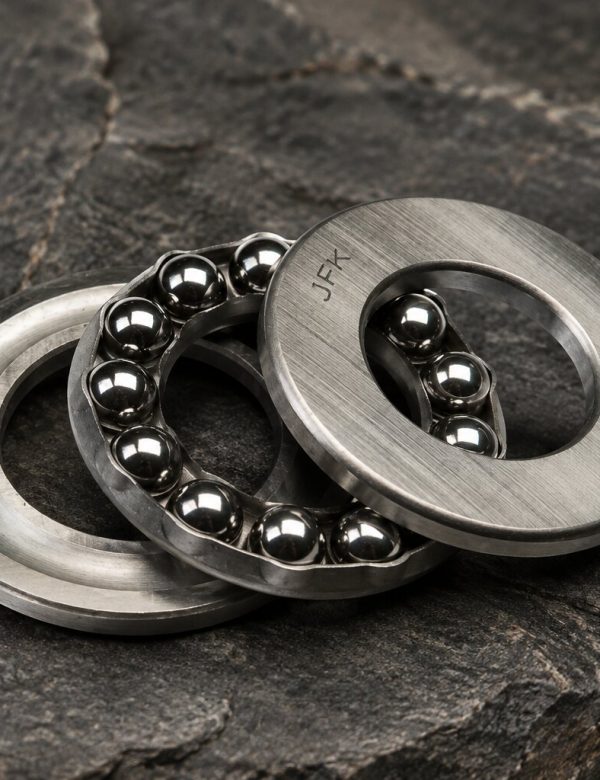
JFK angular contact ball bearings
JFK ball bearings
- High axial loads
- Contact angle up to 40°
- Paired mounting
Angular contact ball bearings are designed to support axial loads acting in one direction and are generally mounted in opposition to a second bearing. The contact angle (40° as standard, also available in 15°, 25°, and 30°) determines the axial load capacity: the larger the angle, the greater the axial load the bearing can support. Thanks to their one-piece design with upper and lower shoulders, each angular contact bearing accommodates a large number of balls, providing relatively high load capacity.
JFK Group offers single-row and double-row angular contact ball bearings. Single-row angular contact ball bearings are the preferred choice for applications with axial loads acting in one direction and are mounted in pairs to accommodate axial loads in both directions. Double-row angular contact ball bearings are equivalent to two single-row angular contact bearings in a reduced axial space, supporting radial and axial loads in both directions without the need for paired mounting.
Versions
How to choose the right angular contact ball bearing
The choice depends on the direction of the axial load and the available space. The single-row version requires paired mounting to accommodate axial loads in both directions, while the double-row version handles loads in both directions independently in a reduced axial space.
Single-row angular contact ball bearings
Series 7000, 7200, and 7300. Reinforced internal design with a standard 40° contact angle. They support axial loads in one direction and must be mounted in pairs for bidirectional loads. Single-row angular contact ball bearings are available in tandem, back-to-back (O), or face-to-face (X) arrangements. Cages are available in pressed steel (J), polyamide (TVP, up to +120°C), solid brass (MP), or phenolic resin (TPA). Standard tolerance class: Normal (PN). Axial load in one direction · High axial stiffness · Paired mounting
Double-row angular contact ball bearings
Series 30.., 32.., and 33... Equivalent to two single-row angular contact ball bearings in a reduced axial space. They support high radial and axial loads in both directions, with the balls arranged in a back-to-back (O) configuration. Available in standard, shielded (ZZ), sealed, or two-piece inner ring designs. Double-row angular contact ball bearings enable rigid bearing arrangements capable of accommodating tilting moments. Bidirectional combined loads · Reduced axial space · High rigidity
Performances
Design and performance features
The contact angle and one-piece design provide high axial load capacity and rigidity across a wide range of mounting configurations.
Load
High axial load capacity The 40° contact angle allows the bearing to support very high axial loads in one direction. The double-row version handles axial loads in both directions without the need for paired mounting.
Contact angle
Available in several versions Standard 40° contact angle (B/BE). Available at 30° (A) for even higher axial loads, 25° (E), and 15° (C) for spindles and high-precision applications.
Mounting
Configuration versatility The single-row version can be paired in a tandem arrangement (loads in one direction), back-to-back (O), or face-to-face (X) arrangement (bidirectional loads). Universal-matching bearings (CB) can be combined in any arrangement.
Speed
Suitable for high speeds The optimized design with a high number of balls ensures good performance even at high speeds. Polyamide cages (TVP) can operate at temperatures up to +120°C.
Internal clearance
Adjusted during installation Internal clearance is established only after installation, by adjusting the bearing relative to the second bearing. Available with light (GA), medium (GB), or heavy (GC) preload.
Tolerances
Standard and optional precision classes Standard tolerance class: Normal (PN). P6 and P5 available on request for high-precision applications.
Mounting
Installation of angular contact ball bearings
Single-row angular contact ball bearings are always mounted in pairs. Internal clearance is established only after installation by adjusting one bearing against the other. For universal-matching bearings (CB), no adjustment is required: the required preload or clearance is obtained by selecting the appropriate class.
Installation Mounting
- Tandem arrangementThe load lines are parallel. Radial and axial loads are distributed equally between the bearings. It supports axial loads in one direction.
- Back-to-back (O) arrangementThe load lines diverge toward the shaft axis. It supports axial loads in both directions, with one bearing carrying the load in each direction. The rigid arrangement is suitable for tilting moments.
- Face-to-face (X) arrangementThe load lines converge toward the shaft axis. It supports axial loads in both directions. Less rigid than the back-to-back (O) arrangement and less suitable for tilting moments.
Technical data
- Load
- High axial load capacity
- Contact angle
- Available in several versions
- Mounting
- Configuration versatility
- Speed
- Suitable for high speeds
- Internal clearance
- Adjusted during installation
- Tolerances
- Standard and optional precision classes
Applications
Applications
Components and application support for every industrial environment.

Industrial automation
Machines with high axial loads and high axial stiffness requirements. The paired back-to-back (O) or face-to-face (X) arrangement ensures positioning accuracy and resistance to tilting moments.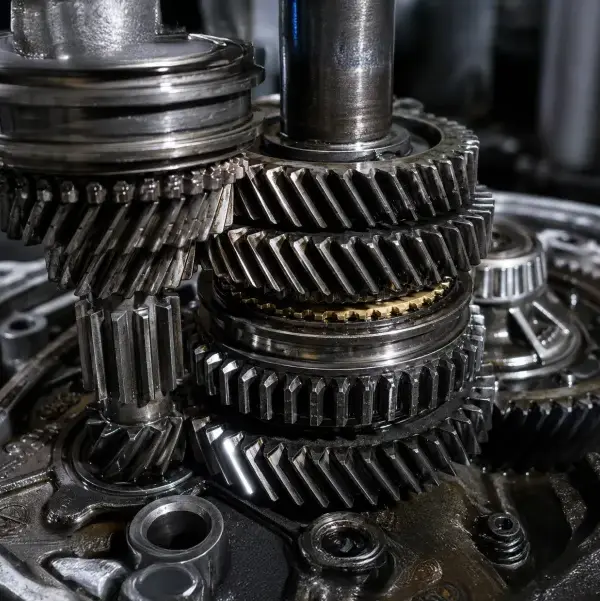
Transmissions and axles
Gearboxes, transmissions, and drive systems with combined radial and axial loads. The double-row version provides the most compact solution for handling bidirectional axial loads.
Automotive / Motorcycles, Trucks & Buses
Pumps, compressors, and drive systems subject to variable axial loads and intermittent load cycles. The 40° contact angle ensures reliable performance even under high axial loads.
Construction Equipment
Fans, blowers, and material handling systems with significant axial loads under severe operating conditions.Documents data

Contacts
Request information about this product
Complete the form for technical information, quotations or trial samples.
Related products
Please also consider these alternatives: When the axial load is moderate and versatility is the priority, deep groove ball bearings are the most widely used and cost-effective solution. When misalignment occurs between the housing and shaft under combined loads, self-aligning ball bearings provide tolerance to alignment errors. For very high combined loads with tilting moments, tapered roller bearings offer higher load capacity than angular contact ball bearings.
JFK high-temperature bearings
High-temperature bearings are rolling bearings made with specialized materials, heat treatments, and lubricants designed to operate at temperatures up to +330°C while maintaining dimensional…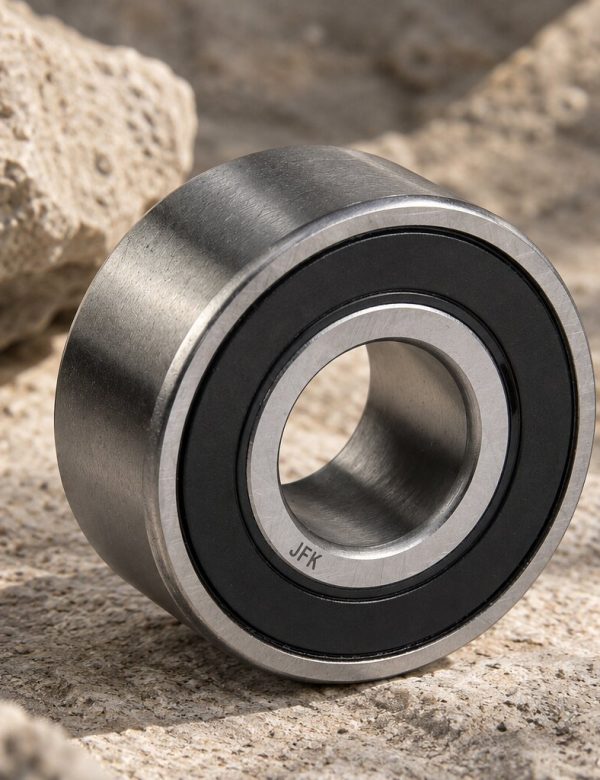
JFK stainless steel bearings
Stainless steel bearings are rolling bearings made from high-performance stainless steel, resistant to oxidation, moisture, and chemicals, designed to operate in harsh environments and…