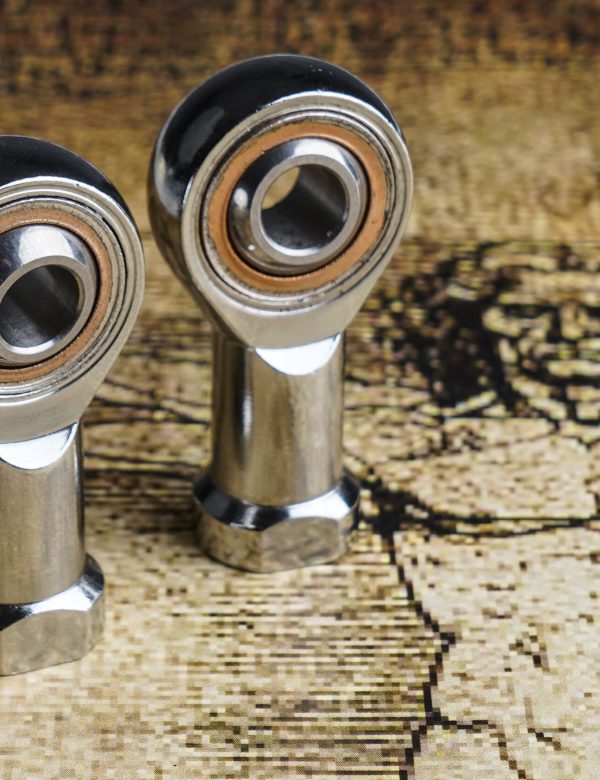
JFK angular ball joints
JFK spherical plain bearings and rod ends
- Angular connection between components
- Available with a hardened spherical head
- An alternative to the clevis fork and pin
JFK angular ball joints, also known as angular joints or angular spherical joints, are connection components designed to join two parts at an angle while providing the freedom of oscillation required to compensate for angular misalignment during operation. They enable the transmission of alternating forces and angular and oscillating movements at low speeds, while compensating for angular deflections and radial displacement, and comply with DIN 71802. They provide a more compact alternative to the traditional clevis-and-pin system when available space is limited or when a single component is preferred over a multi-part assembly.
Versions
Two designs: how to choose the right angular ball joint
The choice depends on the load level and the severity of the anticipated operating cycle.
Standard angular ball joints
Steel ball stud with standard surface treatment. Suitable for applications with moderate loads and operating cycles that are not particularly demanding. Zinc-alloy housing with a PTFE-bronze composite liner and die-cast body; steel ball stud welded to the pin, with a rubber seal protecting the lubricating grease. Series: RBL..RS. Standard design · Moderate loads · Competitive price
Angular ball joints with hardened ball stud
Hardened steel ball stud for increased resistance to wear and deformation under load. Suitable for applications with high loads or demanding, continuous-duty cycles. Compliant with DIN 71802: male carbon-steel pin with a surface-hardened ball stud (>55 HRC), female housing made of 9SMnPb28 steel (Rm >500 N/mm²), with zinc-plated and passivated finish. Series: SA. Hardened ball stud · High loads · Greater wear resistance
Performances
Design and performance features
Compact angular connection between two components, with a hardened ball stud version available for the most demanding loads.
Connection
Angular, compact, an alternative to clevis forks and pins Allows two components to be connected at a defined angle in a single, more compact component than the traditional clevis-and-pin assembly.
Oscillation
Angular misalignment compensation The ball stud allows controlled oscillation, compensating for angular misalignment between the connected components during operation.
Hardened ball stud
Greater wear resistance under heavy loads The version with a hardened ball stud provides a harder, more wear-resistant surface, making it suitable for applications involving high loads or continuous-duty cycles.
Material
Zinc/PTFE-bronze alloy or hardened steel Steel ball stud; zinc-alloy housing with a PTFE-bronze composite liner in the standard version, and steel housing with a surface-hardened ball stud (>55 HRC) in the hardened version. The spherical pairing is lubricated during assembly with NLGI 1 lithium grease.
Mounting
Threaded, without additional components Direct threaded mounting eliminates the need for additional components such as separate pins, clevis forks, or locking elements.
Mounting
Installation of angular ball joints
Installation is carried out by directly threading the joints into the components to be connected, observing the specified tightening torque for the thread and checking the required operating angle during the design phase.
Installation Mounting
- Direct threading into the connected componentsThread the joint into the connected components until fully seated, checking the angular alignment specified in the design before final tightening.
- Locking with a locknut or equivalent systemSecure the thread with a locknut or equivalent safety system to prevent loosening under vibration during operation.
Technical data
- Connection
- Angular, compact, an alternative to clevis forks and pins
- Oscillation
- Angular misalignment compensation
- Hardened ball stud
- Greater wear resistance under heavy loads
- Material
- Zinc/PTFE-bronze alloy or hardened steel
- Mounting
- Threaded, without additional components
Applications
Applications
Components and application support for every industrial environment.

Automotive and motorsport
Suspension and steering systems where a compact angular connection is preferred over a clevis-and-pin assembly to reduce space and weight.
Industrial automation
Angular connections in handling and adjustment systems where misalignment compensation is required in a single component.
Construction Equipment
Heavy-duty applications where the hardened ball stud version provides wear resistance under high loads and continuous-duty cycles.
Metal Fabrication / Machining Industry
Adjustment and angular connection systems between mechanical components requiring compact design and simple installation.
Contacts
Request information about this product
Complete the form for technical information, quotations or trial samples.
Related products
Please also consider these alternatives: When the main movement is linear rather than angular, linear spherical joints are the most suitable solution. For axial connections on rods and tie rods where periodic relubrication is possible. When maximum angular freedom is required or available space allows the use of a clevis-and-pin assembly.
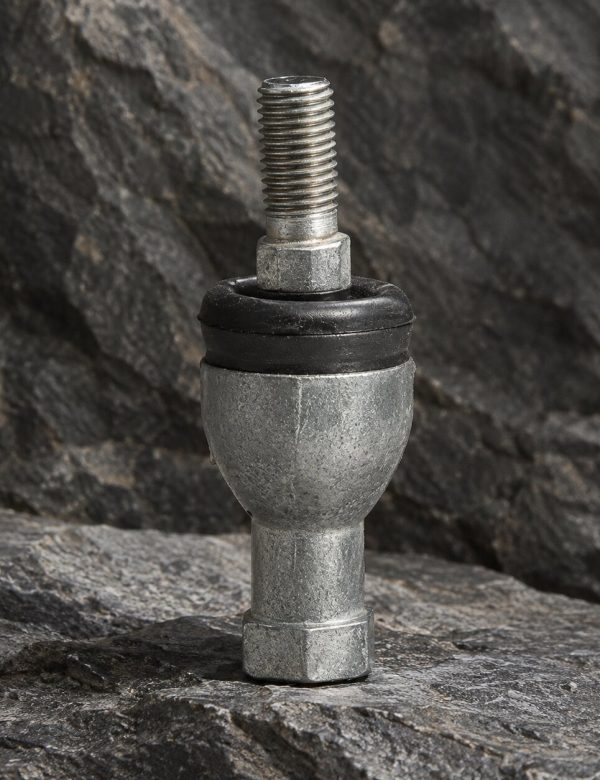
JFK straight ball joints
JFK straight ball joints are connection components designed to transmit predominantly linear tensile or compressive loads along rods and tie rods, while the integrated…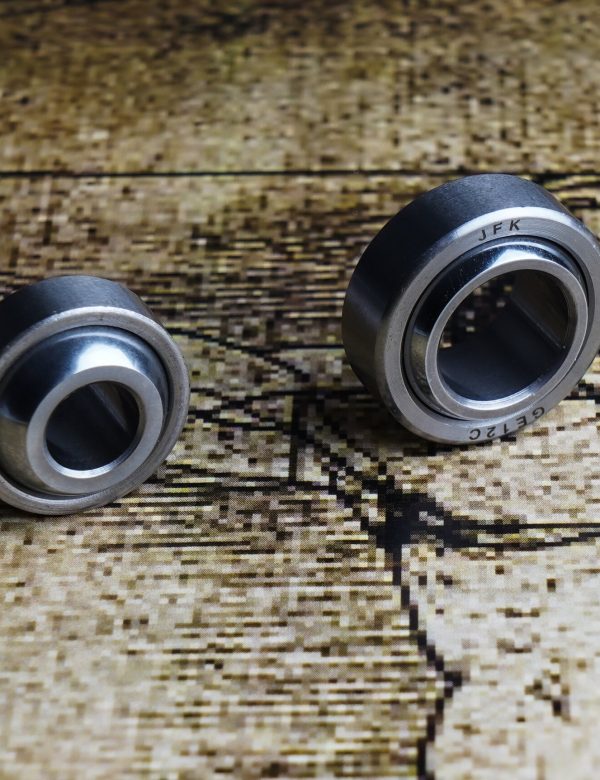
JFK radial spherical plain bearings
JFK radial spherical plain bearings are mechanical components designed to withstand high radial loads, such as those encountered in hydraulic and pneumatic cylinders. The…