JFK angular-contact spherical plain bearings
JFK spherical plain bearings
- Combined loads
- Paired mounting
- Two maintenance versions
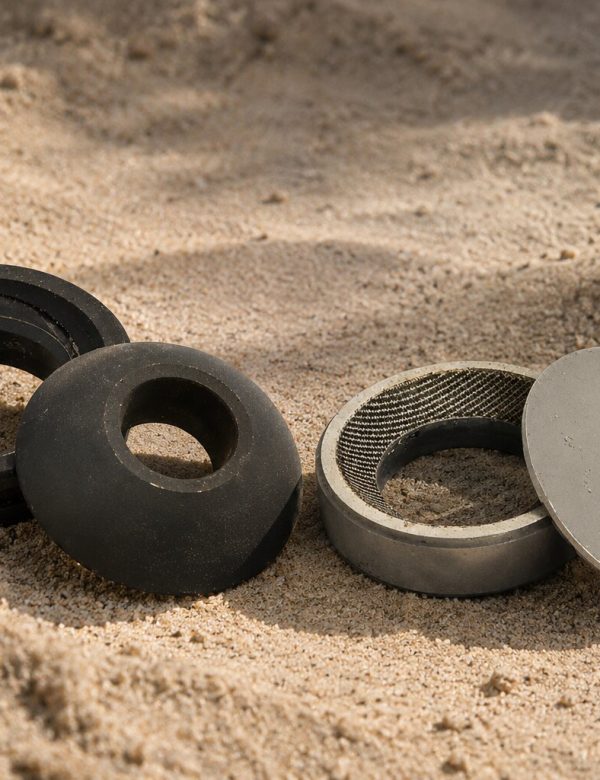
JFK angular-contact spherical plain bearings consist of a shaft race with an external spherical sliding surface positioned at an angle and a housing race with a concave internal spherical sliding surface. This geometry allows them to accommodate combined loads in both axial and radial directions.
By mounting two angular-contact spherical plain bearings so that their sliding surfaces are concentric, they form an assembly that behaves as a single spherical plain bearing capable of withstanding high radial loads and axial loads in both directions. This differs from a single axial spherical plain bearing, which is designed to withstand axial loads predominantly in one direction.
JFK Group offers angular-contact spherical plain bearings in two versions: maintenance-required (steel-on-steel pairing, GAC..S series) and maintenance-free (hard chrome/PTFE pairing, GAC..T series). All dimensions comply with DIN 648 E and DIN 648 K.
Versions
How to choose the right angular-contact spherical plain bearing
The choice depends on the available maintenance conditions and the magnitude of the combined load. Both versions are typically mounted in opposed pairs to handle axial loads in both directions.
Angular-contact spherical plain bearings requiring maintenance
Pairing: steel-on-steel. Compliant with DIN 648 E and ISO 12240. Suitable for high combined radial and axial loads. Require periodic grease lubrication. Series: GAC..S. Steel/steel · High combined loads · Periodic lubrication
Maintenance-free angular-contact spherical plain bearings
Pairing: hard chrome/PTFE. Compliant with DIN 648 K and ISO 12240. Suitable for combined loads in maintenance-free applications requiring low friction. Series: GAC..T.
Performances
Design and performance features
Races with angled sliding surfaces, suitable for opposed-pair mounting for maximum versatility in combined-load applications.
Compliance
DIN 648 E and DIN 648 K · UNI ISO 12240
Load
Combined radial and axial loads The angular contact geometry enables a single component to absorb combined loads, in both the axial and radial directions.
Paired mounting
Axial loads in both directions By mounting two angular-contact spherical plain bearings with concentric sliding surfaces, the assembly behaves as a single bearing capable of withstanding axial loads in both directions.
Pairing
Two versions available Steel/steel for the maintenance-requiring version (GAC..S); hard chrome/PTFE for the maintenance-free version (GAC..T).
Mounting
Installation of angular-contact spherical plain bearings
To take advantage of bidirectional axial load capacity, angular-contact spherical plain bearings are typically mounted in opposed pairs, with the sliding surfaces aligned concentrically within the housing.
Installation Mounting
- Opposed-pair mountingPosition the two bearings with their sliding surfaces concentric and oriented in opposite directions to create an assembly capable of withstanding axial loads in both directions.
- Installation methodsCarry out the initial lubrication before commissioning for the GAC..S version requiring maintenance, then repeat at the specified intervals.
Technical data
- Compliance
- DIN 648 E and DIN 648 K · UNI ISO 12240
- Load
- Combined radial and axial loads
- Paired mounting
- Axial loads in both directions
- Pairing
- Two versions available
Applications
Applications
Components and application support for every industrial environment.

Industrial automation
Systems with combined radial and axial loads, where opposed-pair mounting allows loads to be accommodated in both directions.
Construction Equipment
Heavy-duty applications involving high combined loads, where the maintenance-requiring version offers the highest load capacity.Food and pharmaceuticals
Environments with hygiene requirements where the maintenance-free version eliminates the risk of contamination from lubricant.Packaging and bottling
Machines with continuous-duty cycles and repeated combined loads, where DIN 648 compliance ensures interchangeability and ease of replacement.
Contacts
Request information about this product
Complete the form for technical information, quotations or trial samples.
Related products
Please also consider these alternatives: For load transmission on control rods with misalignment and angular movements. When the load is predominantly radial and bidirectional axial load capacity is not required. When the axial load acts predominantly in one direction only, with no need for installation in pairs.
JFK radial spherical plain bearings
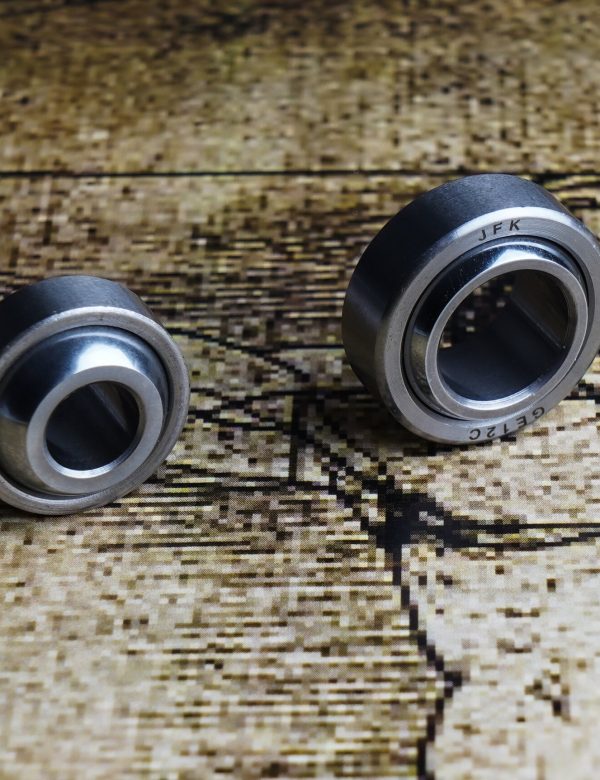
JFK radial spherical plain bearings are mechanical components designed to withstand high radial loads, such as those encountered in hydraulic and pneumatic cylinders. The…