
Insights
Solid-lubricant bearings (BPO, Bearing Plastic Oil) are rolling bearings in which the space between the rolling elements is filled with an oil-impregnated polymer that gradually releases lubricant during operation.
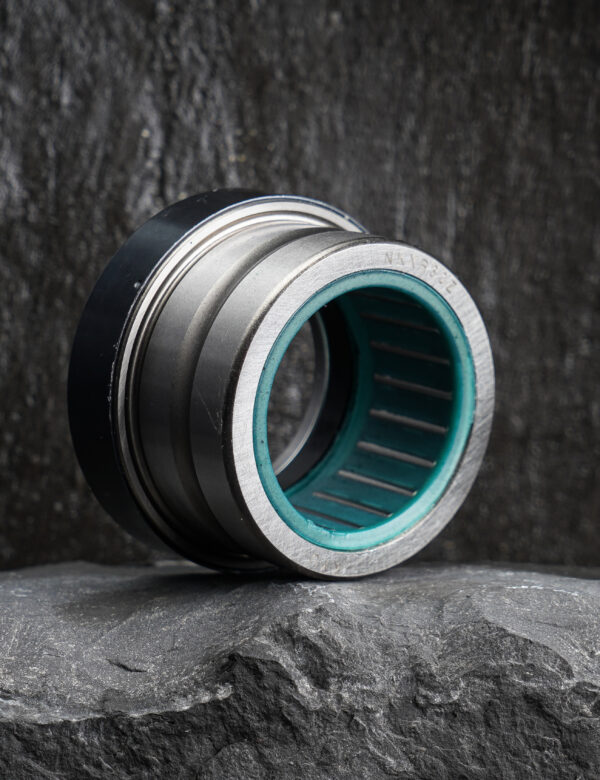
They prevent oil and grease leakage, offer resistance to contamination and chemical agents, and enable maintenance-free operation.
What is solid lubricant?
Along with oil and grease, solid lubricant is one of the solutions used to create a lubricating and protective film between moving surfaces.
Mainly composed of polymers, lubricating oil and additives, it appears as a solid plastic material at the macroscopic level, while under a microscope it reveals a microporous structure that, thanks to molecular forces, retains the lubricating oil within its pores.
During operation, factors such as acceleration, centrifugal force and rising temperatures promote the controlled release of oil from the micropores. The oil reaches the friction surfaces, ensuring proper lubrication. When operation stops, excess oil is reabsorbed by the polymer's porous structure.
This technology makes it possible to manufacture components and inserts in various shapes and sizes using dedicated moulds, including rods, rings, gears and sliders.
One of the main applications is BPO (Bearing Plastic Oil), a type of bearing incorporating solid lubricant.
These bearings are manufactured by injecting the polymer into the internal clearances of the bearing, where it solidifies and performs its lubricating function.
How do BPO bearings work?
In BPO bearings, the space normally left free between the rolling elements is filled with solid lubricant. Once solidified, it forms a body bonded to the cage and rotates together with it, progressively releasing the oil required for lubrication.
What are the advantages of solid-lubricant bearings?
Compared with bearings lubricated with oil or grease, BPO bearings offer several technical and performance benefits:
- Elimination of the risk of lubricant leakage, which is typical of oil- or grease-lubricated bearings.
- Improved performance at low temperatures, thanks to the solid lubricant polymer, which performs better than grease thickeners and allows BPO bearings to operate even at extremely low temperatures.
- High resistance to chemical agents, due to the greater chemical inertness of the polymer compared with the thickeners commonly used in greases.
- Reliable performance under demanding operating conditions, such as frequent starts and stops, bidirectional rotation, reciprocating movements (particularly small-amplitude, high-frequency oscillations), centrifugal forces and shock loads. These are all conditions in which conventionally lubricated bearings may be subject to premature wear.
- High resistance to contamination, further enhanced by the use of shields, which help protect the bearing against the ingress of solid or liquid contaminants.
- Improved corrosion resistance, as the solid lubricant creates an environment that discourages condensation from forming inside the bearing.
- Longer-lasting lubrication and maintenance-free operation, thanks to an oil content that is 2–4 times higher than that of bearings with standard lubricant.
Where are BPO bearings used?
Thanks to their specific characteristics, JFK Group solid-lubricant bearings are used across a wide range of industrial sectors and in particularly demanding operating conditions.
| Industry | Application requirements |
|---|---|
| Food, beverage, tobacco and pharmaceuticals | Lubricant leakage is not permitted; cleaning and high-pressure washing; acidic or alkaline detergents and sterilizing agents |
| Textile and dyeing industry | Grease leakage from bearings is unacceptable; chemical agents in the environment |
| Lifts | Frequent start-stop cycles; difficult disassembly and maintenance; need to prevent lubricant leakage |
| Agricultural machinery | Exposure to dust, mud, rain and large temperature fluctuations |
| Mountain biking and cross-country cycling | Dust, water and mud; variations in speed and load |
| Automotive paint systems | Water and paint mixtures in the environment; need to reduce maintenance downtime |
| Robotics | Complex movements; frequent start-stop cycles |
| Oil drilling | Exposure to weather and large temperature fluctuations |
| Port lifting equipment | Frequent start-stop cycles; exposure to weather and temperature variations; complex maintenance and replacement |
| Medical equipment | Intermittent operation; strict hygiene and contamination prevention requirements |
Do you have an application where conventional bearings fall short?
Find out whether BPO technology could be the right solution for your application.
Email us at info@jfk.group or contact our technical department.